Biomedical & Healthcare Robotics — University of Thessaly
Build the exoskeleton, own a role in it.
The largest student research team in Greece in Biomedical & Healthcare Robotics — and the first Greek team to compete at CYBATHLON, ETH Zurich's global bionics championship.
HERMES Team is recruiting for the 2026–2027 season. Instead of joining a subteam in general, you're joining to own a specific project — with a defined scope, clear collaborators, and a real deliverable for the exoskeleton and CYBATHLON.
Each role below is tied to an actual project on our current roadmap, not a general subject area. Some are ready to start immediately; others begin with scoping, research, or figuring out what's already been done.
Our roadmap is anchored by our flagship project — a new, autonomous, carbon-fiber lower-limb exoskeleton built for CYBATHLON 2028 — but we aren't stopping there. We're expanding into brain-computer interfaces, a tendon-driven robotic hand, motion capture, and mobile rehabilitation technology, plus a training ground for rookies and a dedicated research track.
Roles aren't rigid lanes — cross-subsystem collaboration is part of how HERMES works, and it comes up naturally in the work itself, not as a separate box to check.
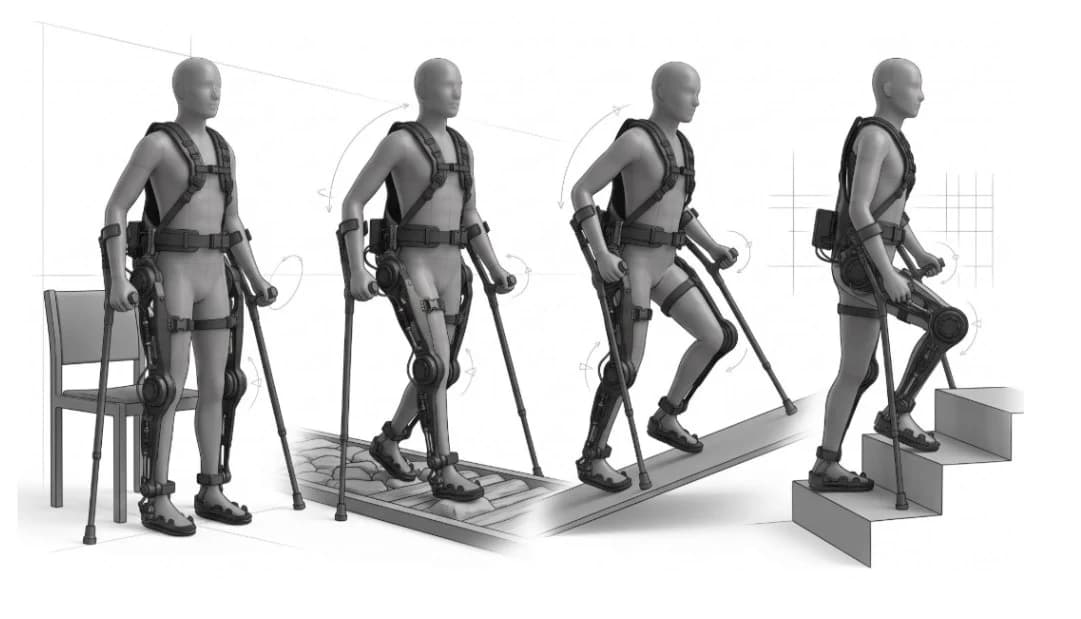
Forged from the principles of advanced bipedal humanoid robotics, engineered to redefine human mobility. The ultimate exoskeleton for the CYBATHLON 2028.
Core Architecture
Reinforced CF Chassis: Ultra-lightweight.
20+ Sensor Network: Zero-latency telemetry flow.
12-DOF System: Greater device control, simulating human movement.
MPC Control: Stable bipedal locomotion.
Modular Ergonomics: Universal pilot adjustability.
High-Precision Motors: Linear & Rotary Actuation.
Dynamic RL Locomotion
Adaptive real-time gait stabilization.
Autonomous Navigation
AI-driven spatial obstacle detection.
Concept Design
4 roles
Software & AI
Builds and maintains the software that runs the exoskeleton — from sensors and motor commands to the pilot's interface — all governed by a central state machine and tested in simulation first.
Software Architecture Engineer
Design the core system that lets the exoskeleton sense what's happening, decide what to do, and act on it.
Scope and design the Central Control Unit's architecture, built on ROS 2
Build error handling in as an ongoing part of the system
Build the telemetry system — a real-time database that captures live sensor and status data
Build the control screen used to operate the exoskeleton during sessions and testing
Coordinate with other subsystems on what the control unit needs to expose
Motor Communications Engineer
Get commands from the control system to the motors quickly and reliably.
Evaluate communication protocols such as CAN bus and EtherCAT for real-time, safety-critical performance
Design and implement the motor communication architecture the rest of the system runs on
Simulation Engineer
Test and improve the exoskeleton's control software safely in simulation, before it runs on real hardware.
Evaluate NVIDIA Isaac Sim and Gazebo, robotics simulation platforms, as environments for training and testing reinforcement-learning control policies
Benchmark against project needs once infrastructure is in place
Computer Vision Engineer
Give the exoskeleton the ability to recognize its surroundings, so it can adjust to stairs, slopes, and obstacles.
Build the camera vision pipeline for object and obstacle detection
Apply it to terrain recognition — stairs, inclines, level ground
Integrate LiDAR into the pipeline for SLAM-based spatial mapping
4 roles
Kinematics & Control
Generates the exoskeleton's movement trajectories, keeps them within safety and power limits, and closes the loop with sensor feedback so the system tracks them precisely.
Kinematics & Motion Planning Engineer
Work out how the exoskeleton should move, translating human motion across different challenges into robotic trajectories.
Analyze human motion during specific CYBATHLON tasks to define accurate movement requirements
Perform kinematic analysis and motion planning using MATLAB to extract models and generate reference trajectories
Formulate and improve mathematical methods (e.g. Direct Collocation) for optimal trajectory generation
Modeling & Simulation Engineer
Check whether the mechanical and control designs actually work together in a physics-based environment, before they're built.
Develop and validate physics-based multibody dynamics models using MATLAB and Simulink
Construct the digital twin (e.g. in Twin Activate), integrating control systems, sensor data, and bi-directional data exchange
Ensure the modeled environment accurately reflects real-world physics for reliable control testing
Control Systems Engineer
Design the brain of the movement, deciding how the exoskeleton balances and tracks trajectories in real time.
Design and implement Model Predictive Control (MPC) algorithms in Simulink for stable, closed-loop trajectory tracking
Use real-time sensor feedback to adjust high-level control outputs dynamically
Research novel high-level controller architectures as a parallel track
Motor Controls Engineer
Carry a control decision through to the right, precise motor movement.
Implement and tune low-level PID controllers, interfacing directly with MAXON motor controllers and drives
Manage and transition between operational modes (e.g. Position, Velocity, or Profile) and setpoint generation within one pipeline
Research and integrate torque mode control before physical implementation begins
2 roles
Embedded System
The bridge between hardware and software — designs embedded systems, programs microcontrollers, and connects sensors and components so they work together seamlessly.
Motor Controller Firmware Engineer
Give the motors their own dedicated hardware, so the main system isn't slowed down by managing them directly.
Research and implement a custom STM32-based motor controller network
Reduce the load on the central system by handling time-critical motor control locally
Sensors Engineer
Get every sensor on the exoskeleton reading reliably and feeding data back to the system.
Implement and deploy EMG sensors for muscle activity monitoring
Implement IMU-based motion tracking, including filtering and data collection
Implement load cells, strain gauges, and encoders for force and position sensing
Evaluate existing capture and force-analysis tools (e.g. OpenCap) where they can save time over building from scratch
4 roles
Electrical & Electronics
Designs the custom PCBs that manage the exoskeleton's electronics — optimizing power distribution, reducing electrical noise, and using thermal simulation to keep the system safe and reliable.
PCB Design Engineer
Design high-reliability printed circuit boards for complex electronic systems.
Design component schematic symbols, PCB footprint layouts, routing, and stackups
Prototype, bring up boards, and perform signal integrity testing
Thermal Engineer
Keep the exoskeleton's electronics from overheating during use.
Run thermal analysis on components and PCBs
Identify thermal issues and validate with hands-on measurement
Battery Systems Engineer
Provide enough power, safely, for a full session.
Own battery architecture, BMS, charging, protection, and power budget
Run hands-on battery and power measurements
Electrical Design Engineer
Wire and connect every part of the electrical system correctly.
Create and maintain schematics, wiring diagrams, pinouts, harnesses, and connector layouts for the full system
Take part in hands-on wiring, integration, and testing
4 roles
Mechanical Design
Designs the exoskeleton's physical structure in CAD, selects the right materials, and uses CAE simulation to improve performance.
Mechanical Design Engineer
Redesign the exoskeleton's physical frame from metal into a lighter, 3D-printed carbon-fiber structure.
Model the frame, structural links, and pilot cuff interfaces in 3D CAD
Run motion and clearance studies across the full walking cycle to avoid mechanical collisions
Align joint axes and strapping mounts with pilot biomechanics for natural movement
Additive Manufacturing Engineer
Turn 3D-printed carbon-fiber parts into load-bearing components that replace heavy metal hardware.
Benchmark carbon-fiber filaments for strength, weight, and print reliability
Calibrate print settings — orientation, infill, thermal — to maximize strength and avoid warping
Print, inspect, and prep structural parts for assembly onto the physical robot
Simulation Engineer (FEA)
Find out where the frame is over-built, and cut weight without sacrificing strength.
Run structural FEA on load-bearing parts to check safety margins and stress points
Use topology optimization to strip redundant material and guide lighter designs
Adapt the simulation workflow to account for how 3D-printed parts behave under load
Mechatronics Engineer
Select and integrate the motors and gearboxes that actually drive the exoskeleton's joints.
Compare drive architectures and select motors and transmission ratios for each joint
Report on torque-speed requirements, thermal limits, and weight trade-offs
Mount and align the actuators onto the exoskeleton frame
2 roles
Brain-Computer Interface (BCI)
Builds OuroborosNet, the deep-learning architecture that connects a pilot's thoughts directly to the exoskeleton's movement.
Neural Signal Processing Engineer
Translate raw, noisy brain activity into clean, usable data for the neural network.
Process and filter signals from a 32-channel passive-electrode EEG system with minimal latency
Develop algorithms to decode the noisy, non-stationary nature of EEG data, with real-time artifact rejection
Extract signal features for Motor Imagery (MI), P300, and SSVEP paradigms to feed the decoding models
Deep Learning & Neural Decoding Engineer
Build the AI architecture that translates human thought into real-time robotic movement.
Design, optimize, and train the OuroborosNet deep learning architecture for a resilient, closed-loop control system
Implement the Multi-Control Task-Adaptive Paradigm, adapting decoding strategy to the exoskeleton's current state
Fuse Motor Imagery (MI) intentions with P300 and SSVEP inputs for fast, intuitive movement handling
6 roles
Regrasp Project
Builds a tendon-driven robotic hand — from fingers and actuators to the sensors, control, and learning that make it grip — toward a modular end effector for patients, robot arms, and humanoids.
Hand Mechanical Design Engineer
Design the fingers, joints, and tendon routing so the hand is strong, light, and repeatable.
Redesign the finger and palm mechanism in CAD, with tendon routing and joints for low friction and long life
Prototype and iterate parts with 3D printing, using rigid and flexible materials
Test grip force, range of motion, and durability, logging every result
Actuation & Transmission Engineer
Decide how the hand moves — motors, gearing, and tendon drives.
Evaluate actuators (servos, BLDC, geared DC motors) against force, speed, size, and weight targets
Design the drive from motor to tendon — spools, gearing, tensioning — and shrink its size and weight
Measure torque, backlash, and efficiency on the bench
Hand Kinematics & Control Engineer
Model how the hand moves and design the control that turns a command into a stable grip.
Build the kinematic and tendon-force model of the hand in MATLAB/Simulink or Python
Design and tune control loops for finger position and grip force, defining grasp types (power, pinch, tripod)
Work with Embedded System to move control from simulation to the real hand
Hand Electronics & Embedded Engineer
Build the electronics and firmware that read the sensors and drive the motors.
Design the PCB, power, and wiring for sensors and motors
Write firmware in C/C++ for sensor reading, motor control, and communication
Evaluate better sensing options — force sensors, encoders, alternatives to flex sensors
Hand Machine Learning Engineer
Use data from the hand's sensors to make it grip smarter.
Build the data-logging pipeline for every test the team runs
Detect slip and contact from force and motor-current signals, and improve user-intent detection
Prototype a vision model that picks the right grasp for an object